One Note to Rule Them All
A love letter to the genre that makes people ask "is your speaker broken?"
Music does things to people. Some genres make you feel nostalgic and happy. Some get you feeling sad, while others make you angry or hyped-up. I’m not going to give examples because, let’s be honest, we’re all different and what gets me hyped-up might be the exact thing that makes you sad.
There’s one genre I listen to that most people aren’t keen on, and that genre is: Drone. So what exactly is it?
Drone?
Drone music is built around sustained tones, minimal harmonic movement, and repetition. Instead of focusing on melody or rhythm in the traditional sense, it emphasizes texture, atmosphere, and gradual change over time. The sound can feel meditative, hypnotic, or even overwhelming, depending on how it’s performed.
Types of Drone
Let’s be clear, there are a lot of Drone subgenres. I mostly listen to drone-metal, with the main proponent of that subgenre being Sunn O))) (pronounced “Sunn”), but here’s a more formal (yet incomplete) list:
Drone Metal (Drone Doom): The heaviest and most physically intense subgenre. It uses massive, down-tuned guitars, heavy distortion, and feedback. It is meant to be felt as much as heard, often lacking traditional percussion.
Ambient Drone (Drone Ambient): A softer, more textural approach that prioritizes atmosphere and spatial sound. It often overlaps with New Age and focuses on creating a sense of calm or introspection.
Dark Drone / Dark Ambient: Characterized by ominous, low-frequency rumbles, industrial noises, and a “horror” or “catacomb” atmosphere. It often uses minor keys and dissonant overtones.
Minimalist / Avant-Garde Drone: The “academic” roots of the genre. Emerging in the 1960s, it focuses on the mathematical and psychoacoustic properties of sound, often using “just intonation” or very slight frequency shifts.
Drone Rock / Space Rock: Rock music that ditches traditional chord progressions in favour of a single, sustained harmonic centre. This style often uses motorik beats or repetitive psychedelic rhythms.
Folk / Traditional Drone: This category includes centuries-old traditions that use instruments specifically designed for droning, such as the Scottish bagpipe (pibroch), the Indian tanpura, or the Australian didgeridoo.
Blackened Drone: A fusion of Black Metal and Drone. It takes the “wall of sound” and tremolo picking of black metal but removes the speed and drums, resulting in a bleak, freezing atmosphere.
…and there’s more than this still.
The History of Drone
You might be surprised to discover that drone isn’t something new. When I first started listening to what I thought was drone music, it was actually drone-metal. I was fascinated to discover that one of my favourite bands in that subgenre wasn’t the originators (not even close!).
I went back to 1993 and found Earth, who released an EP called “Earth 2: special low frequency version” which was ahead of its time (at least in the subgenre of drone-metal). But then I discovered no… a popular sludge band called The Melvins released an EP called “Joe Preston” (named after their bassist at the time) which seems to be one of the earliest known recorded drone-metal releases.
ℹ️ INFO
I discovered many years later Joe Preston covering live bass duties for one of my favourite bands SUMAC.
Again, at this point, what I’m thinking of as drone was actually drone-metal, and so my mind was suitably blown when someone much older than me told me to go check out The Velvet Underground’s song “Loop” (from 1966). It’s not quite the same as drone-metal but it’s unmistakably drone.
So I started digging into the history and realised, why of course, this is an ancient sound. A spiritual tool. The goal was often to induce a trance state or represent the infinite. Drone was the “eternal hum” that mimics everything from the wind in caves to the circulatory system in our own ears.
Let’s consider some of the ancient roots:
Indian Classical Music: The Tanpura is perhaps the most iconic drone instrument. It provides a continuous harmonic foundation that represents the “unstruck sound” of the universe.
Aboriginal Australian Traditions: The Didgeridoo (Yidaki) has been used for over 1,000 years, using circular breathing to create an unbroken, resonant low frequency.
Byzantine and Gregorian Chant: Early Christian music often featured an “isison,” a lower vocal part that held a single steady note while other voices moved above it.
Bagpipes: From Scotland to Iran, the drone pipes of various bagpipe traditions provide a constant harmonic floor that creates that “wall of sound” effect.
So when did we start transitioning from “ancient ritual” to “art movement”? Well, we have a few people to thank for that…
- Luigi Russolo (1910s): Wrote The Art of Noises, celebrating industrial hums and machinery.
- La Monte Young (1950s): Often called the “Daddy of Drone.” He focused on “sustained tones” and created a 6 hour movement called “The Well-Tuned Piano”**.
- Tony Conrad & John Cale (1960s): Members of the Theatre of Eternal Music. Cale took these “dream chord” ideas straight into The Velvet Underground.
- Brian Eno (1970s): Defined Ambient Music. His work moved drone from the “challenging avant-garde” into a soothing, atmospheric space.
ℹ️ NOTE
I’ve tried listening to “The Well-Tuned Piano”, but it’s too sparse for me.
Why Drone?
So… what is it about drone music that makes it so appealing to people?
Think about it. Inside the womb, a fetus is surrounded by a constant, 24⁄7 wall of sound. This isn’t just a quiet hum; it’s often measured at 70 to 90 decibels, roughly the volume of a vacuum cleaner or a loud shower. Because the baby is submerged in amniotic fluid, high-frequency sounds from the outside world are muffled, leaving a thick, bass-heavy drone.
This is why we often play “white noise” to calm babies when they go to sleep. The sudden silence of a nursery can actually be startling and stressful. White noise signals their nervous system that they are safe. This is also why many adults listen to white noise when they go to bed.
💬 CITE
Silence is deafening.
– Thomas Carlyle (Circa 1831)
It’s not the noise that wakes you. It’s the inconsistency of sound. In a silent room, a floorboard creak or a car door slamming creates a massive spike in acoustic energy. The drone “fills in” the acoustic gaps, making sudden noises much less likely to trigger the brain’s “alert” reflex.
Now, we’ve been talking about “white” noise, but really there are multiple colours:
White: Equal energy per frequency. Sounds like a harsh hiss (think radio static). Rarely used as a melodic element but often serves as a “wall” in harsh noise music.
Pink: Equal energy per octave. Sounds more balanced to the human ear, like falling rain or leaves rustling. In drone, this is often the sweet spot for creating a sense of natural space.
Brown: Energy decreases as frequency increases. Much deeper and bass-heavy, like a distant roar or a low rumble.
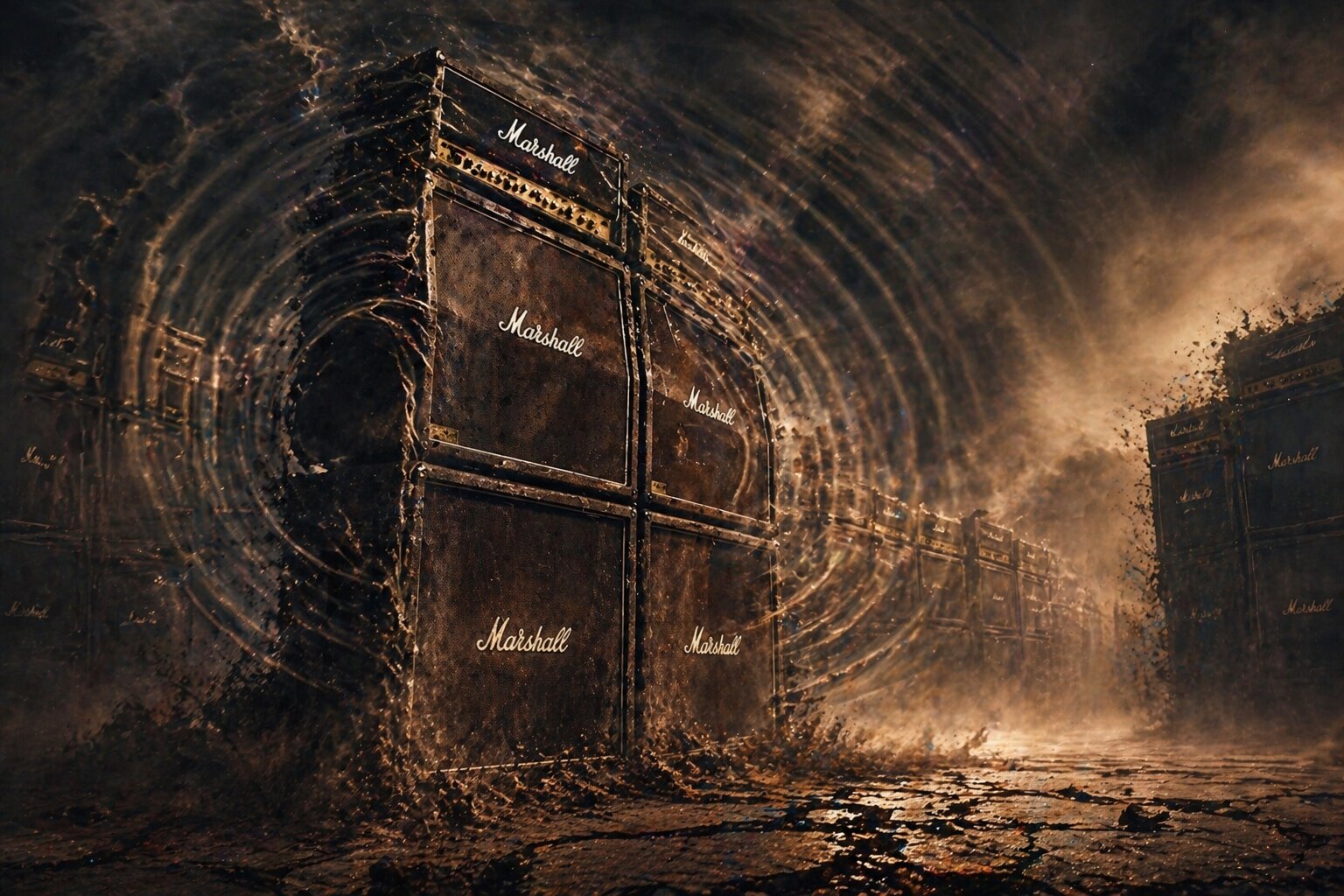
When talking about drone-metal (which is what I’m focused on), what we’re really talking about is the amplification of brown noise. The goal is often to vibrate the listener’s body. This requires a heavy concentration of low-end energy, and brown noise is mathematically the closest noise colour to the sound of a wall of dimmed amplifiers vibrating at sub-bass frequencies.
Drone-metal guitarists use massive amounts of distortion and fuzz. As you add more gain, the signal clips, adding harmonic content that begins to resemble white or pink noise. Controlled feedback loops act as a living, breathing noise floor that the musician sculpts over time.
While white noise can feel clinical or irritating, brown noise provides the warmth and doom essential to the drone-metal aesthetic.
At a basic level, drone strips music down to time + tone. When you remove melody and rhythm, your attention shifts. There’s also a physical angle: sustained low frequencies literally vibrate your body, which makes the experience less intellectual and more visceral.
With repetition and no clear “events,” your brain stops anticipating what’s next. Because nothing is demanding your attention, your thoughts start to surface. For some, that’s clarity. That ambiguity is the point. Unlike most music, drone doesn’t tell you what to feel; it creates a space where feeling happens.
For me, drone (or specifically drone-metal) makes me feel like I’m being swallowed by a black hole. By being engulfed in sound, it helps me lock out any other thoughts. It’s very much a meditative experience.
…ever breathe a frequency?
Have you ever been so surrounded by a sound that it feels like it’s part of your body; like you’re inhaling and exhaling it? It’s less about music as entertainment, and more about music as an environment you inhabit.
Sunn O)))’s live shows have a very physical impact on their audience. With their use of volume, their sound turns into a bodily experience. You don’t just hear it…you feel it.
Sunn O))) are one of the most famous modern groups connected to drone music. But they didn’t start there.
Stephen O’Malley and Greg Anderson formed Sunn O))) in 1998. Both came from heavier, more structured backgrounds. O’Malley had been playing in Burning Witch, a doom/sludge band that leaned into slow, punishing riffs but still had vocals, song structure, and recognisable metal form. Anderson was in Goatsnake, a stoner doom band with grooves you could actually nod along to.
Their shared obsession was Earth. Specifically, the Earth 2 EP I mentioned earlier. That record was already stripping out drums and vocals to leave nothing but massively amplified, glacially slow guitar. O’Malley and Anderson wanted to take that idea further. Not just slow and heavy, but dense.
Their early recordings (the ØØ Void and Flight of the Behemoth era) still had traces of metal DNA. There are moments of black metal influence, particularly in the atmosphere. That frozen, cavernous quality, that bands like Burzum and Darkthrone were known for. But where black metal achieved that feeling through speed and tremolo picking, Sunn O))) achieved it through absence. No blast beats. No shrieks. Just massive, sustained chords decaying into overtones.
By the time White1 and White2 came out (2003-2004), the transformation was more or less complete. These records aren’t metal in any conventional sense. They’re explorations of texture, volume, and physical space. White1 features collaborations with people outside the metal world entirely, like Merzbow and Rex Ritter (who brought analogue synths into the mix). This was Sunn O))) becoming something closer to a sound art project that happened to use guitar amplifiers.
The Black One (2005) is where things get really interesting. It’s their most overtly “metal” record since the early days. There are vocal contributions from Wrest (Leviathan/Lurker of Chalice) and Malefic (Xasthur), both one-man black metal projects known for isolation and claustrophobia. As the story goes: Malefic recorded his vocals while locked inside a coffin 😬 (helping to capture the spirit of the record).
From there, the collaborations kept expanding. Altar (2006) with Boris blended their drone with Boris’s more dynamic range. Monoliths & Dimensions (2009) brought in brass, choirs, a trombone soloist, and arrangements by Eyvind Kang. By this point, calling them a metal band felt genuinely inaccurate. They’d evolved into something that sat between doom metal, academic composition, and performance art.
Their more recent work, Pyroclasts (2019) and Metta, Benevolence BBC 6Music: Live on the Invitation of Mary Anne Hobbs (2021), leans further into the meditative side. Pyroclasts was built from improvised drone sessions recorded at the beginning and end of each day during the Life Metal sessions. It’s some of their most accessible work, and also some of their most beautiful.
What makes Sunn O)))’s evolution worth tracing is that it wasn’t a clean break from metal. Each release peeled away another layer of conventional structure until what remained was pure tone and physical presence. They didn’t reject their roots. This was simply boiling them down to their essence.
ℹ️ INFO
Sunn O))) took their name (and logo) from Sunn Musical Equipment, an American amp company that ran from the 1960s through the early 2000s. The O))) part? That’s the company’s original sun logo! They basically named themselves after their favourite amplifier.
Drone-metal Hall of Fame
If you’ve made it this far, then you’re probably someone who has the right level of curiosity to want to try out some drone-metal. So here are some tracks worth starting with. Most of these are Sunn O))) because, well, I love them. I’ve thrown in a couple of older tracks that predate Sunn entirely (as mentioned earlier), because you can’t appreciate where drone-metal ended up without hearing where it started.
Hands First Flower
The Melvins - Joe Preston (1992)
Before Earth 2, before Sunn O))), there was this. The Melvins’ Joe Preston EP (named after their bassist at the time) is one of the earliest proper drone-metal recordings. “Hands First Flower” is a slab of slow, crushing, feedback-drenched guitar that just sits there. There’s no progression in the traditional sense. It’s a single idea stretched to its breaking point. Coming from a band known for sludgy punk riffs, this was a sharp left turn that basically said: what if we just played one thing and made it unbearably heavy? It predates Earth 2 by a full year, which makes it arguably the first recorded moment where someone thought “what if doom metal, but less?”
Seven Angels
Earth - Earth 2: Special Low Frequency Version (1993)
If “Hands First Flower” planted the seed, “Seven Angels” grew it into something enormous. This is 20 minutes of a single, massively amplified guitar chord decaying and regenerating over and over. Dylan Carlson (Earth’s guitarist) tuned his guitar absurdly low and let the harmonics do the work. There’s no drums, no vocals, no structure. Just a wall of tone that shifts like weather. Earth 2 didn’t push drone-metal into the mainstream (nothing ever really has), but it exposed the idea to a much wider audience. Without this EP, Sunn O))) probably doesn’t exist, at least not in the form we know them.
Etna
Sunn O))) & Boris - Altar (2006)
Altar is the collision of two bands who approach heaviness from completely different angles. Boris bring dynamics, rhythm, and a willingness to actually move between ideas. Sunn O))) bring the glacial weight. “Etna” is where those two approaches fuse most effectively. It builds from near-silence into something genuinely volcanic (the title isn’t subtle about it). Boris’s Atsuo plays drums on this record, which is notable because Sunn O))) almost never use percussion. The result is drone with forward momentum, which sounds like a contradiction but works beautifully.
Kannon 1
Sunn O))) - Kannon (2015)
After the sprawling orchestral ambition of Monoliths & Dimensions, Kannon was a deliberate step back. Three tracks, all called “Kannon”, all built from the same basic elements: guitar, amplifier, feedback, voice. The album takes its name from the Japanese bodhisattva of compassion, and there’s a ritualistic quality to it. “Kannon 1” opens with that familiar low rumble, but there’s a clarity to it that the earlier records didn’t have. It feels focused rather than sprawling. Less “look what we can do” and more “this is all we need.”
Aurora
Sunn O))) - Life Metal (2019)
Life Metal is the warmest thing Sunn O))) have ever made. Recorded with Steve Albini at Electrical Audio, the production is remarkably clean for a band built on distortion and feedback. “Aurora” captures that shift perfectly. There’s a tangible positivity in the sound that’s hard to describe if you’re used to their earlier, more oppressive work. The harmonic overtones ring out instead of collapsing into mud. It still vibrates you, but it feels like sunlight rather than suffocation. This is the record I’d give to someone who’s never heard Sunn O))) and might actually want to enjoy the experience.
Frost ©
Sunn O))) - Pyroclasts (2019)
Pyroclasts was born from the Life Metal sessions. At the beginning and end of each recording day, the musicians would improvise a drone piece together, no plan, no structure, just tone. “Frost ©” is one of those improvisations, and it’s some of the most meditative music Sunn O))) have produced. Where Life Metal had shape and direction, Pyroclasts just floats. It’s the closest they’ve come to pure ambient drone, and it’s genuinely beautiful in a way that would surprise anyone who only knows them from the robed, fog-machine era.
Troubled Air
Sunn O))) - Metta, Benevolence BBC 6Music: Live on the Invitation of Mary Anne Hobbs (2021)
This is a live recording, and it takes “Troubled Air” (originally from Life Metal) and stretches it into something much larger. The extended arrangement brings in jazz elements that weren’t present in the studio version, with brass and woodwind weaving through the drone. It’s Sunn O))) at their most collaborative and expansive. The live setting adds an unpredictability that suits the improvised nature of their music. You can hear the room, the space between the instruments, the moments where the musicians are listening to each other and deciding where to go next.
Evil Chuck
Sunn O))) - Evil Chuck EP (2023)
Named after Chuck Schuldiner (founder of Death, the band widely credited with pioneering death metal), this EP is Sunn O)))’s tribute to someone who pushed boundaries in a completely different direction. The track itself is dense and low, even by their standards, with a funereal quality that suits the dedication. There’s a reverence to it. Where a lot of metal tributes try to imitate the artist they’re honouring, Sunn O))) did what they always do: they filtered the idea through their own process and turned it into pure tone.
Raise the Chalice
Sunn O))) - Eternity’s Pillars (2025)
Eternity’s Pillars continues the trajectory that Life Metal and Pyroclasts set in motion. “Raise the Chalice” has a ceremonial weight to it. The title suggests ritual, and the music delivers on that. It’s slow, layered, and patient in a way that rewards repeated listening. Each time through, you hear overtones and textural details that weren’t apparent before. This is Sunn O))) fully settled into what they are: not a metal band, not an ambient project, but something that exists in the sustained space between the two.
Glory Black
Sunn O))) - Sunn O))) (2026)
Their self-titled Sub Pop debut, and it feels like a statement of arrival (thirty years in). “Glory Black” is the standout. Piano and nature elements run throughout the record, which is a significant departure from their usual palette of guitar and amplifier. The piano doesn’t soften the music so much as give it a different kind of weight. There are moments where field recordings of wind and water surface beneath the drone, grounding it in something organic. It’s Sunn O))) acknowledging that the sound they’ve spent decades building doesn’t have to come from a guitar.