47 Minutes in the Cosmic Woodchipper
Why a 47-minute panic attack about non-existence is secretly Meshuggah's ultimate comfort album.
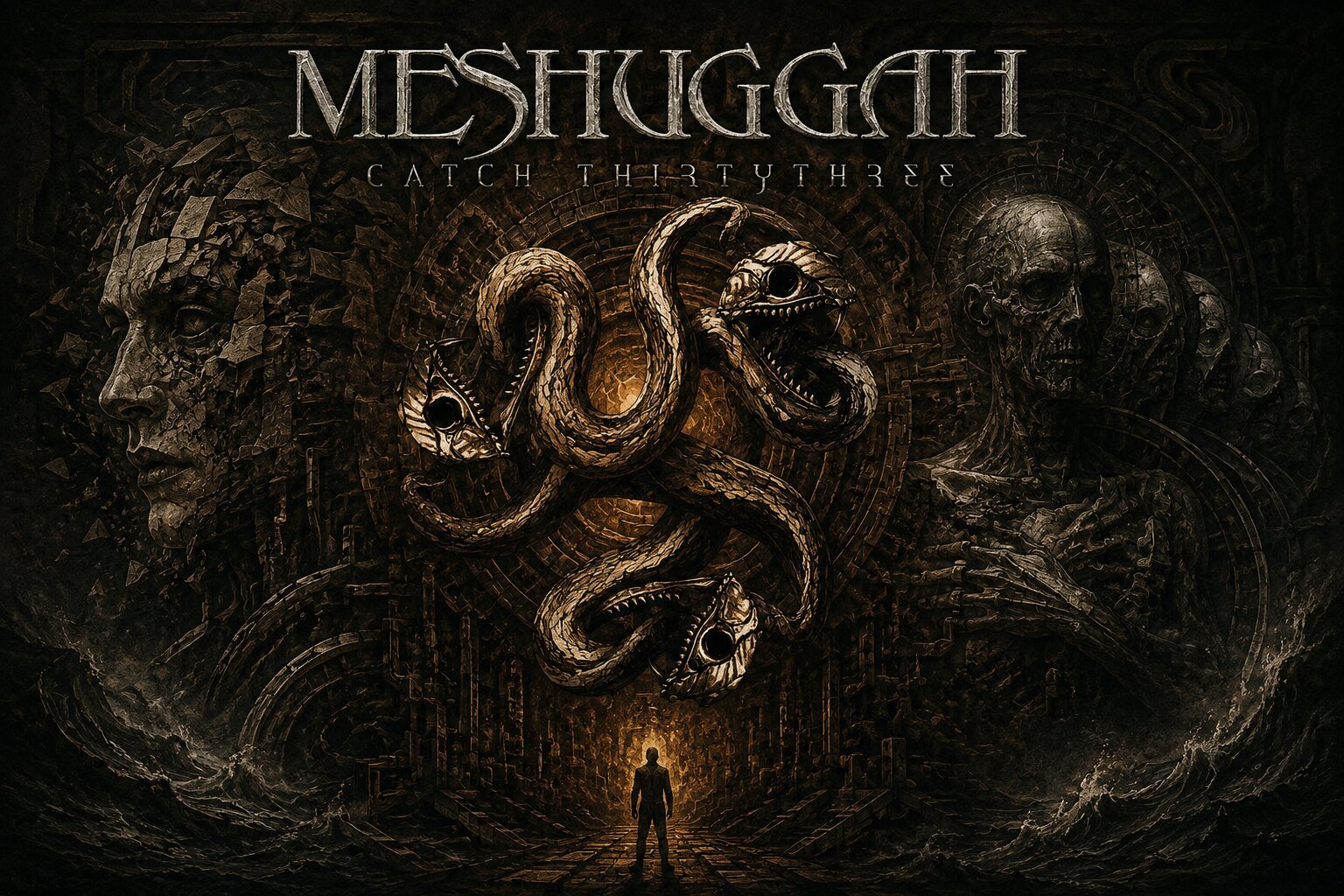
To the uninitiated, listening to Meshuggah feels a bit like sticking your head inside an industrial washing machine that is undergoing a violent, highly rhythmic seizure. It is loud, it is abrasive, and it is entirely uncompromising. If you play it in the car with your family, they will almost certainly ask what the hell is wrong with you.
But for those of us who dwell in the murky depths of heavy, avant-garde music, Meshuggah is something else entirely. They are not just a band. They are a controlled, safe dose of the void.
And while everyone loves to debate whether Destroy Erase Improve or ObZen is their finest hour, the real truth, the one we only whisper about when the purists are not looking, is that 2005’s Catch Thirtythree is their absolute masterpiece.
Here is why.
The Monolith (And the Drum Machine That Outsmarted Us All)
What makes Catch Thirtythree so special?
For starters, it is not a collection of songs. While technically split into thirteen tracks, it is actually a single, continuous 47-minute suite structured across four distinct movements. It is a song cycle, a monolith of musical architecture that demands your undivided attention. In an age of TikTok attention spans and three-minute singles, Catch Thirtythree is a towering monument that says: “Sit down, shut up, and let us disassemble your mind.”
Then there is the great drum controversy.
When the album dropped in 2005, metal purists threw an absolute fit because Tomas Haake did not record the drums live. Instead, the band programmed them using a software toolkit called Drumkit from Hell. At the time, this was seen as a betrayal of extreme metal’s physical athletic code.
But in hindsight? It was a stroke of absolute genius.
The cold, sterile, inhumanly precise nature of the programmed drums is not a compromise. It is a fundamental feature of the art. The album’s lyrics deal with post-human dissolution, robotic repetition, and the mechanical nature of our own meat-suit existence. What could possibly be more appropriate than an actual machine delivering the backbone of that nightmare? Haake’s programming is so incredibly meticulous that it sounds like a sentient computer having a beautifully calculated nervous breakdown.
And let us not forget the drop.
You know the one I mean. The transition from the eerie, vocoded, ambient space of Mind’s Mirrors into the absolute, bone-shattering violence of In Death (Is Life). It is widely regarded by fans as one of the most satisfying and cathartic drops in all of metal history. It is the moment the trap door opens and you are plunged directly into the woodchipper.
The Jungian Woodchipper: Why We Need the Void
In my previous post about Death, I talked about how my own thanatophobia, that constant, low-frequency hum of mortality, has kept me awake since I was six years old. I spent decades trying to escape that panic, only to realize that my constant struggle to escape death had actually shackled me to it.
That is exactly what Catch Thirtythree is about.
The album’s title is a play on Catch-22, a situation where you cannot win because of contradictory rules. In the Meshuggah universe, the “Catch-33” is the human ego. The more you try to understand yourself, the more you try to claw your way out of your own mental constraints, the more you realize that the “self” is the ultimate trap. The struggle to be free is what binds you.
The album cover itself, three interlocked serpents forming an endless loop of self-consumption, is a perfect visual representation of this cycle.
A lot of people do not understand why some of us gravitate towards such chaotic, heavy sounds. They hear the noise and they think it is angry or depressive.
They have got it completely backwards.
We listen to this chaotic noise because it is louder than the chaos already raging inside our own heads. My monkey mind is so chatty, paranoid, and terrified of oblivion that I need something colossal to drown it out. Playing Catch Thirtythree is like taking my ego, wrapping it in lead, and throwing it into a black hole for 47 minutes. It is the only art I have found that stares directly at non-existence without flinching, making a beautiful, horrifying sound out of the void.
The Architecture of the Nightmare: The Four Movements
While the track listing shows thirteen distinct songs, anyone who has listened to the album with their eyes closed (and perhaps a mild sense of existential dread) knows this is not a collection of individual tracks. It is a single, continuous piece of music. More specifically, it is a symphony in four movements.
Each movement serves as a distinct phase in the systematic destruction of the ego, transitioning from frantic resistance to complete, mechanical peace.
Movement I: The Frantic Resistance (Tracks 1–3)
Autonomy Lost / Imprint of the Un-Saved / Disenchantment
This is the setup of the ultimate catch. The seeker begins with a desperate search for enlightenment (the “essence-sun of dreaming bliss”), but because this search is fueled by a fear of the dark, it is doomed from the start. We see the seeker realizing that their “jigsaw of redemption” is made of formless, shifting lies. The movement ends with a frantic, suffocating panic attack where the seeker tries to hold their breath to escape.
This group of tracks is the “hope” phase, which is quickly crushed. Musically and lyrically, it is about the friction of the ego trying to save itself. The tracks run on the exact same unrelenting, mechanical riff, mirroring the looping panic of a mind realizing it is trapped in its own skin. The harder you fight to be free, the tighter the shackles get.
Movement II: The Cold Paralysis (Tracks 4–6)
The Paradoxical Spiral / Re-Inanimate / Entrapment
Having realized that active struggle only tightens the handcuffs, the seeker tries a different, equally doomed tactic: playing dead. First, the panic spirals and intensifies into absurd contradictions, drowning the seeker in the “endless sky.” Then, they freeze entirely, casting their gaze on oblivion and entering a state of non-sensory matter. If they pretend to be a rock, maybe death will ignore them. But this complete detachment backfires, causing the mind to fracture into a “multitude of laughters” and a shattered personality.
This movement is the transition from frantic panic to cold, clinical dissociation. The ego tries to protect itself through absolute apathy, but instead of finding peace, it completely loses control. The body rebels against the mind, and the seeker is left standing among a thousand laughing copies of themselves.
Movement III: The Mirror and the Kill (Tracks 7–9)
Mind’s Mirrors / In Death - Is Life / In Death - Is Death
This is the turning point and the absolute peak of the album. It begins in the quiet, eerie, vocoded space of a mirror, where the soul tries to consume its own reflection. It is an infinite, terrifying feedback loop. The only way out is to smash the mirror, which triggers the most cathartic drop in metal history. The seeker plunges into ego death, feeling vibrant and alive in a grey, dead world. But there is a horrifying twist: by becoming vibrant, they become prey to the void’s predators, only to realize they are the monster eating themselves.
These three tracks are the core of Catch Thirtythree. They represent the transition from the intellectualized paradox of the self (the mirror) to the raw, terrifying reality of ego-death. You cannot outsmart the void; any attempt to find “life” in death only feeds the predator within.
Movement IV: The Sublime Dissolution (Tracks 10–13)
Shed / Personae Non Gratae / Dehumanization / Sum
The violent struggle is finally over. In Shed, the seeker gives up and simply jumps, only to find that the “self” was just a heavy coat they could discard. They look back at their old identity and realize it was just an unwelcome guest (a persona non grata) anyway. This leads to a state of complete, mechanical peace where logic is gone, the absence of air lets them breathe, and the grinding noise of the universe becomes the sweetest sound. All opposites collapse into a final, beautiful mathematical equation where true are all lies.
This final movement is the clean-up crew of the mind. The violent, messy ego-death of the previous movement is replaced by a post-human, serene emptiness. It is the transition from the horror of losing yourself to the sublime, quiet beauty of having nothing left to lose.
Let us break down this 47-minute descent into the abyss, track by track, and see what these lyrics are actually implying.
1. Autonomy Lost: Guided by the Dark
💬 QUOTE
Reaching for the inner bright, the very essence-sun of my dreaming bliss
Guided by a fear blinded outside all shades of the perfect black
The album begins with a seeker reaching for some kind of spiritual enlightenment (the “inner bright” or “essence-sun” of bliss). But there is a massive catch right out of the gate: this search is guided entirely by a blinding, primal fear. The “perfect black” represents a comfortable state of ignorance or non-existence, but the seeker’s fear of it blinds them. In trying to escape the dark, they lose their self-control. Their autonomy is lost before the journey even begins.
2. Imprint Of The Un-Saved: The Formless Jigsaw Puzzle
💬 QUOTE
The scattered jigsaw of my redemption laid out before my eyes
Each piece as amorphous as the other, each piece in its lack of shape a lie
The seeker tries to find a path to salvation or wholeness. They look at the “jigsaw of my redemption” laid out before them. But the pieces are formless, shifting, and completely “amorphous.” You cannot build a coherent self when the building blocks themselves are illusions. The attempt to find redemption is revealed to be a lie because there is no solid, separate “you” to save.
3. Disenchantment: Holding Your Breath Until You Turn Blue (And Other Great Escape Plans)
💬 QUOTE
Me, the paragon of fear, an immobile skein of tangled nerves exposed
Hastily clawing my way into the darkest of my inner scenes of torture
I stay my breath to escape this slavery
I stay my breath to re-awake and face it encore
The struggle to free myself of restraints, becomes my very shackles
Here we hit the core paradox of the entire album. The seeker is completely paralyzed by existential panic (an “immobile skein of tangled nerves exposed”). To escape this mental slavery, they try to “stay my breath” (to withdraw from life, to suppress their own consciousness). But this very act of suppression and struggle is what locks them in. The harder you fight against your own mind, the tighter the handcuffs get. The struggle is the shackle.
4. The Paradoxical Spiral: Choking on Fresh Air
💬 QUOTE
Non-physical smothering. Asphyxiation by oxygen hands
Drowning in the endless sky. An ever-downward dive, only to surface
the sewage of indecision, on which all sense of self is afloat
The vortex-acceleration a constant. Resolute in purpose its choking flow
The panic intensifies into a literal spiral of physical and psychological contradictions. We get some of the most striking imagery on the album: “Asphyxiation by oxygen hands” and “Drowning in the endless sky.” The very things that should sustain life (oxygen, the open sky) are what are actively choking and drowning the seeker. There is a relentless downward dive, but instead of hitting bottom, they keep surfacing in the “sewage of indecision.” The ego is drowning in its own inability to choose, caught in a spiraling vortex of its own making.
5. Re-Inanimate: If I Pretend I’m a Rock, Death Can’t Find Me
💬 QUOTE
My ignorance cast in the mold of all things absolute
I sustain forever my gaze. A stare fixed on the distant oblivion
Resting in the inverted state of being dead, non-sensory matter
As all the earth, the wind, the fire, the sea behold and learn to pity me
Faced with the exhausting torment of indecision and fear, the seeker chooses absolute paralysis. They freeze. They fix their stare on the “distant oblivion” and enter an “inverted state of being dead.” By pretending to be non-sensory matter, they can no longer feel the fear of dying. But it is a hollow victory. They have turned themselves into a statue of ignorance, and even nature itself (the earth, wind, fire, and sea) looks on in pity.
6. Entrapment: When Your Bones Start Making the Decisions
💬 QUOTE
Mutiny of self. Insurrection games convincingly performed
Incapacitated by physical thoughts acting out the will of tendon and bone
Have the bridges of insanity been crossed and forever retracted?
Am I standing among a thousand selves? Is the multitude of laughters mine alone?
The mind finally begins to fragment and dissociate. “Mutiny of self” implies that the body has rebelled against the conscious mind. The seeker feels like a spectator in their own skin, incapacitated while their physical body (“tendon and bone”) acts out its own mechanical will. They look around and realize the bridge back to sanity has been burned. They are standing among “a thousand selves” (a shattered personality), hearing a chorus of laughter, and wondering if they are the one laughing at their own madness.
7. Mind’s Mirrors: The Mirror-Chewing Paradox (Please Do Not Try This at Home)
💬 QUOTE
The feeding frenzy of my starving soul, gnawing voraciously at the bones,
the exo-skeletal patchwork protecting my own reflection within;
The twin-and-same engaged in the mirrored act of chewing away
at the shell of my attacking self. The paradox unseen
Treacherous this deceit to make no choice matter
To have and yet lose yourself, until finally all reasons why are forgotten
To live through ones own shadow. Mute and blinded, is to really see
Eclipse the golden mirror and the reflection is set free
The absolute peak of ego-consumption. The seeker’s “starving soul” is gnawing at its own skeletal armor, trying to get to the reflection inside. But because it is a mirror, the reflection is doing the exact same thing back. It is a horrific, infinite feedback loop of self-consumption. The seeker realizes the ultimate trap: trying to define the self by looking in the mirror is a “treacherous deceit.” The only way to be set free is to “Eclipse the golden mirror.” You must smash the ego’s false image of itself, even if it means plunging into darkness. To be mute and blinded is, ironically, the only way to really see.
8. In Death - Is Life: Twitching on the Dancefloor of the Cosmos
💬 QUOTE
So imminently visible, this cloaked innocent guilt
Sentenced to a lifetime, a second of structured chaos
Trampled by the ferocious, raging crowds of solitude
I’m the soil beneath me soaking up the sustenance of my own death
Extradited to the gods of chance, the deities of all things random
Alive, multicolored, twitching in their dead monochrome world
This is the transition point, matching the absolute explosion of the music. The seeker begins to experience the death of their old self. Life is described as a prison sentence (“Sentenced to a lifetime, a second of structured chaos”) where we are trampled by “raging crowds of solitude.” But by accepting this death, the seeker becomes “the soil” soaking up the sustenance of their own decay. They are handed over to pure randomness (“gods of chance”) and suddenly become “multicolored” and “alive,” twitching in a dead, grey, monochrome world. It is the paradox of finding life only when you stop fighting death.
9. In Death - Is Death: Congratulations, You Are Now Your Own Predator
💬 QUOTE
Iridescent to the searching eyes, I’m all things vivid in a world of grey
So easily spotted, so easily claimed in this domain where all is prey
My thoughts a radiant beacon to the omnidirectional hunter-god radar
I’m a markerlight of flesh to these subconscious carnivores
I am them. I am teeth. I’m their arousal at the kill
Feasting on self. A schizoreality warp. The contradiction fulfilled
Focus the only means to see me back to life’s unending swirl
A reversal of passing away, as the world of dead, as away is now my origin
But the paradox does not stop at liberation. By becoming vibrant and iridescent in a world of grey, the seeker has made themselves a target. They are now highly visible “prey” to the “subconscious carnivores” of the void. And then comes the ultimate, terrifying twist of the knife: “I am them. I am teeth.” The predator and the prey are one and the same. The ego is devouring itself in a “schizoreality warp.” The contradiction is fulfilled. The seeker tries to focus to pull themselves back to “life’s unending swirl,” but they cannot escape, because the “world of dead” is now their actual origin.
10. Shed: Taking Off Your Ego Like a Heavy Winter Coat
💬 QUOTE
I float through physical thoughts. I stare down the abyss of organic dreams
All bets off, I plunge, only to find that self is shed
The struggle finally ends. No more fighting the current, no more trying to outsmart the paradox, and no more panic. The seeker stands at the edge of the abyss and simply jumps. “All bets off, I plunge.” And in that terrifying moment of letting go, they make an incredible discovery: they did not die. The “self” was just a heavy, useless coat that they finally managed to shed.
11. Personae Non Gratae: Realizing Your Entire Identity Was an Unwelcome Guest
💬 QUOTE
A lie to maintain equilibrium, to hold me in this dead realm, this last ever dream
I’m the thought that never crossed my mind, disguised in the evident. Forever unredeemed unredeemed_
The aftermath of ego-death. The seeker looks back at their old identity and realizes it was just a “persona non grata” (an unwelcome guest). The coherent “I” was just a comforting lie told to maintain equilibrium in a dead realm of existence. Now, free from that lie, the seeker is “the thought that never crossed my mind,” representing a vast, formless state of being that is forever unredeemed by conventional, boring logic.
12. Dehumanization: Sticking Your Head in the Cosmic Washing Machine
💬 QUOTE
A new level reached, where the absence of air lets me breathe
I’m inverted electrical impulses. A malfunctioning death-code incomplete
All things before me, at first unliving glimpse undeciphered
Its semantics rid of logic. Nothing is all. All is contradiction
Grinding, churning, the sweetest ever noises
Decode me into their non-communication
A soundtrack to my failure, one syllable, one vowel
A stagnant flow of endings. Un-time unbound. Merging to form the multi-none
A sickly dance of matter, malignantly benign. Greeting the chasm, unbearable, sublime
This is the post-human, mechanical landscape of absolute dissolution. Dehumanization is not presented as a tragedy; it is a “new level reached.” In this state, “the absence of air lets me breathe.” The physical rules of life are completely inverted. The grinding, churning noise of the universe (which sounds exactly like Meshuggah’s guitars) becomes “the sweetest ever noises.” The seeker is decoded into “non-communication” and merges into the “multi-none.” The chasm is both unbearable and utterly sublime.
13. Sum: The Math Exam Where All Answers Are Correct
💬 QUOTE
Vision will blind. Severance ties. Median am I. True are all lies
The absolute summation. All dualities and opposites collapse in on themselves. Sight is what blinds us; severing ties is what actually binds us to the whole. The seeker is the “median” (the thin, impossible edge between life and death, self and void). In this state of ultimate, beautiful paradox: true are all lies.
Greeting the Chasm
Catch Thirtythree is not an easy listen. It is not something you play in the background while doing your taxes or washing the dishes. It is a demanding, claustrophobic, and occasionally terrifying journey through the mechanics of your own existential dread.
But that is exactly why it is their best album.
It does not offer easy answers. It does not tell you that everything is going to be okay, or that there is a kindly old man in the sky waiting to hand you a harp when you die. Instead, it looks directly into the black, gaping chasm of oblivion, smiles its crooked, mechanical smile, and matches its heartbeat to the void.
And for 47 minutes, you get to stand on the edge of that chasm, feeling the wind blowing through you, completely safe in the knowledge that your ego is temporary, your fear is a paradox, and the noise is the only thing that can save you.
Because let’s face it, one day the self will be shed. We might as well have a sick soundtrack for the plunge.