Death
Panic-buying immortality since 1988.
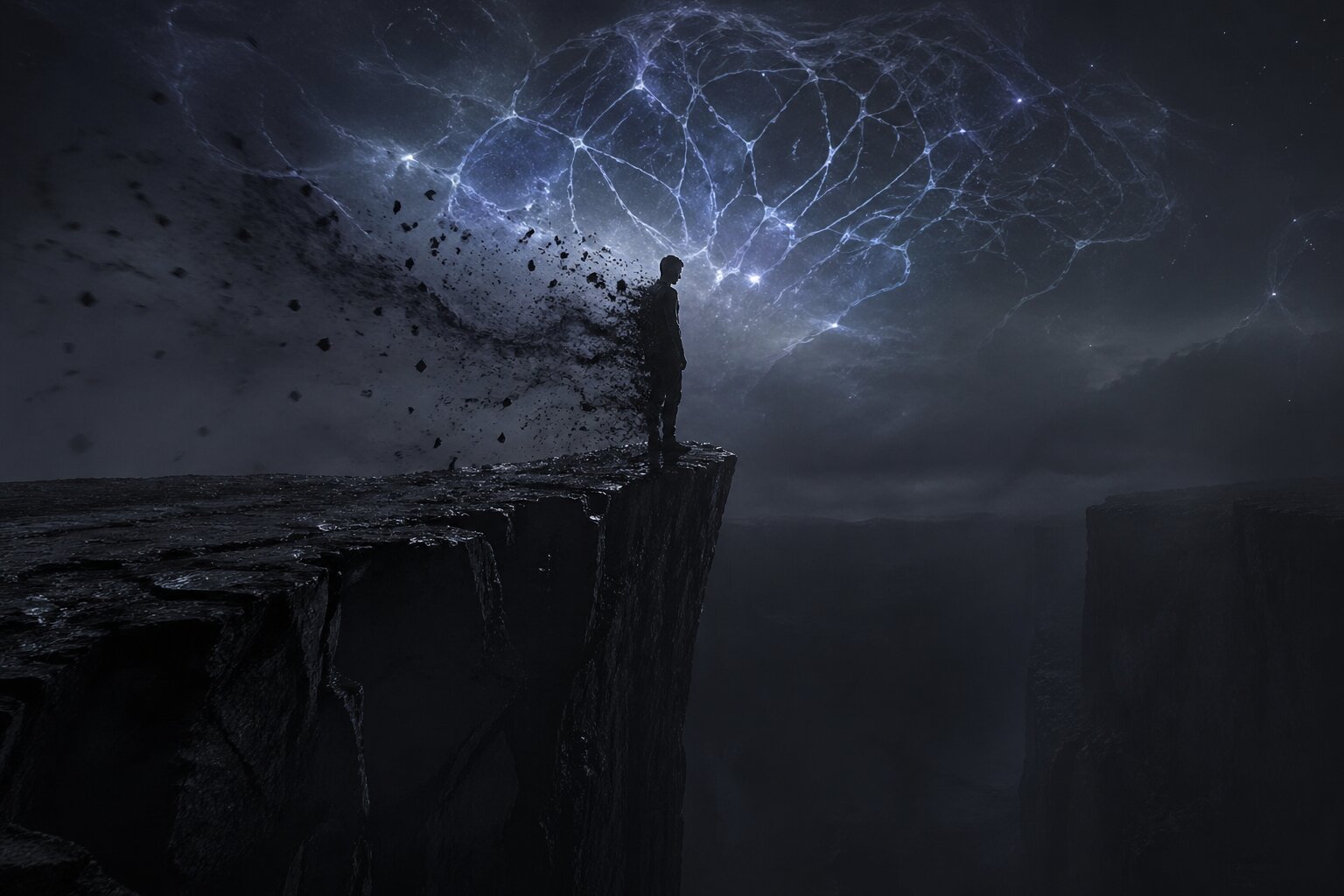
Ever since I was six years old, I’ve been scared of dying.
I’m not talking about the “scared to die” that most people will occasionally admit to before getting on with their day. I mean the kind of scared that cripples you on a daily basis and stops you from sleeping. The kind that triggers daily panic attacks if you don’t work very hard to sidestep them, because let’s be honest, this is a fear you can’t escape.
There’s actually a clinical term for this: Thanatophobia. Derived from the Greek thanatos (death) and phobos (fear), it describes a profound and often debilitating anxiety about the process of dying or the concept of non-existence.
It’s perfectly natural to feel uneasy about the “great unknown”, but thanatophobia goes beyond typical concern. It becomes a clinical anxiety disorder when it starts to interfere with your daily life.
The night my brain broke
Very early on. Unfortunately.
I remember the moment vividly, and I often wonder: if certain things had happened slightly differently that night, would I have ended up as damaged as I did?
I was lying in bed, just thinking to myself, as kids often do at bedtime. (I know this because my two kids are never more verbal about what’s rolling around inside their heads than the exact moment I try to close the bedroom door so I can finally get a glass of wine and relax after what was likely a very long day.)
Whatever I’d been thinking about (I’m pretty certain it involved how cool Heaven would be and all the things I could do “up there”), the thoughts stopped. And I said to myself: “but… what if there IS NO God?”
The thought just sat there, rolling around my head, while my mind scrambled for anything in my experience or knowledge bank that could save me from the panic that was rising.
Once you start thinking “what if God doesn’t exist?”, the next obvious question is: “what happens when you die?” As a child, I equated death with God. Any time you talk about death around children, you’re usually talking in terms of God and Jesus (in the Western world at least). Death wasn’t associated with anything else. So take God out of that equation and there’s not much left to hold it all together, not at that age anyway.
Once the panic took hold (and let’s not kid ourselves, it was going to take hold, and it was not going to let go), I started crying and screaming because my little brain had begun to unravel at the horror of oblivion. Not that I knew what the concept was at the time. It would be many years before I’d learn the word for it, or for nothingness.
I ran out of my bedroom in absolute hysterics just as my mum had started coming up the stairs to put my older sister to bed. I started babbling “I’m gonna die. I’m gonna die” over and over. Now, understandably (and I only really came to appreciate this once I had kids of my own and experienced the daily nightmare of getting two young children to bed), she was on the cusp of wrapping up a very long day of looking after two kids all by herself. My dad worked away from home for months at a time, so there wasn’t much of a male role model in sight. Having to deal with me getting out of bed and screaming something incomprehensible was not something she was going to suffer any nonsense for.
So what did she do? She hustled me back into bed. She didn’t listen. She didn’t try to understand why I was upset. She just wanted me out of the way so she could get my sister down and finally have a well-deserved rest. As a parent of two, I fully understand this now. But for many years I resented her for it, because of the damage that night ultimately caused.
I should be clear: I’ve never spoken to my mum about this incident, nor about how crippled I am by my fear of death. It’s something I never really spoke to anyone about until I explained it all to my wife, many years later. I think we’d been together 13+ years before I first told her why I was having a panic attack at bedtime, something I’d hidden from her as best I could. But on that occasion it just had me defeated, and I think I was tired of keeping the secret and not being able to release the weight from my shoulders.
Every. Single. Night.
Every night (and I do mean quite literally, every night) I would have panic attacks about dying. My mum had shooed me away the first time, which meant this wasn’t a topic up for discussion. So I had to deal with it myself.
This was the early 80s. I didn’t have access to anything as futuristic as “the internet” to find out what this meant, or to discover that other people felt it too. I was alone. Stranded on an island of anxiety with no escape.
It wasn’t until my late teens that I learnt to use breathing and meditation.
I’d found some old Buddhist books in the local library, very dense reading for
a teenager with ADHD, but I stuck with them because they felt important and
might finally be the answer I was lookinghoping for. I stumbled across a
copy of “The Tibetan Book of the Dead”, a sacred text originally dating back to
the 8th century, and its talk of The Bardo was fascinating to me.
Through that I discovered Carl Jung, the Swiss psychiatrist and founder of analytical psychology. Jung had written extensively about his own near-death experience and how he correlated the process of dying with his branch of psychology. He didn’t create the concept of the “ego” (that honour went to his mentor Sigmund Freud), but he interpreted it as something that needed to die. Or more precisely, the ego had to be dissolved, giving way to what he called “the Self”, in order for a person to step beyond their physical being and accept that they were part of a wider net of consciousness (hello Alex Grey). Jung believed that what religions call “God” is actually a psychological reality experienced as the Self.
Part of Jung’s work involved studying dreams and how they might offer insight into the unconscious mind. This led me down the path of Lucid Dreaming. I was interested because I hated going to sleep, and as we know, that started very young. I’d wake up in the morning with no recollection of falling asleep and no memory of having dreamt, so I equated being asleep with being dead. A dreamless sleep was death. I didn’t know it had happened, and that was just too real. Too scary.
The path to lucid dreaming was a fun journey: setting alarms to wake myself up at different times during the night to see if I could catch myself mid-dream, writing some of them down so I didn’t forget (and wow, I had some weird dreams). The idea was that my body could get used to being woken up, and my brain would start to “wake up” while I was still dreaming, and thus begins the ability to lucid dream, to be aware you’re dreaming and to control it. But ultimately this was a journey of self-gratification, as I clearly just wanted to do naughty things in my dreams.
“Have you tried talking to someone?”
Honestly, I saw no point. Either way, nothing could be done about it. I felt so confident that death was, and is, the end, that talking to a psychiatrist would just be a waste of money and time. What were they going to tell me? “Oh it’s ok, we all get scared of dying; it’s very natural.” I know it’s natural. Doesn’t mean I have to like it.
I also, selflessly, didn’t want to fuck up anyone else. There’s an old proverb:
💬 CITE
“Ignorance is bliss”
– Thomas Gray (Ode on a Distant Prospect of Eton College)
This is demonstrated rather well in The Matrix, in the scene where a disgruntled crew member, Cypher, meets secretly with Agent Smith to negotiate his betrayal of the story’s hero. While savouring a digital steak, Cypher explicitly acknowledges that the meat is an illusion (electrical signals sent to his brain), yet he chooses to embrace the simulation anyway. “Ignorance is bliss.” He agrees to hand over critical information in exchange for being reinserted into the Matrix with his memories erased. His character is a warning of the “Blue Pill” philosophy: the idea that a comfortable, high-status lie is preferable to the cold, exhausting reality of the truth.
For me, if I talked about this with others, their ignorance (happily going about their day without thinking about death) would be disrupted by me revealing some dark secret, and they’d spend the rest of their days worrying about when they would die. I just didn’t want to do that to anyone. And to make it worse, you can’t know if someone is ignorant without first talking to them about it, which is exactly how you start their mind thinking about the subject you’re trying not to bring up.
Somewhat tangentially similar are the following lyrics from the Meshuggah album Catch 33. The album is a single song divided up into 13 separate movements:
💬 CITE
“The struggle to free myself of restraints, becomes my very shackles”.
– Disenchantment
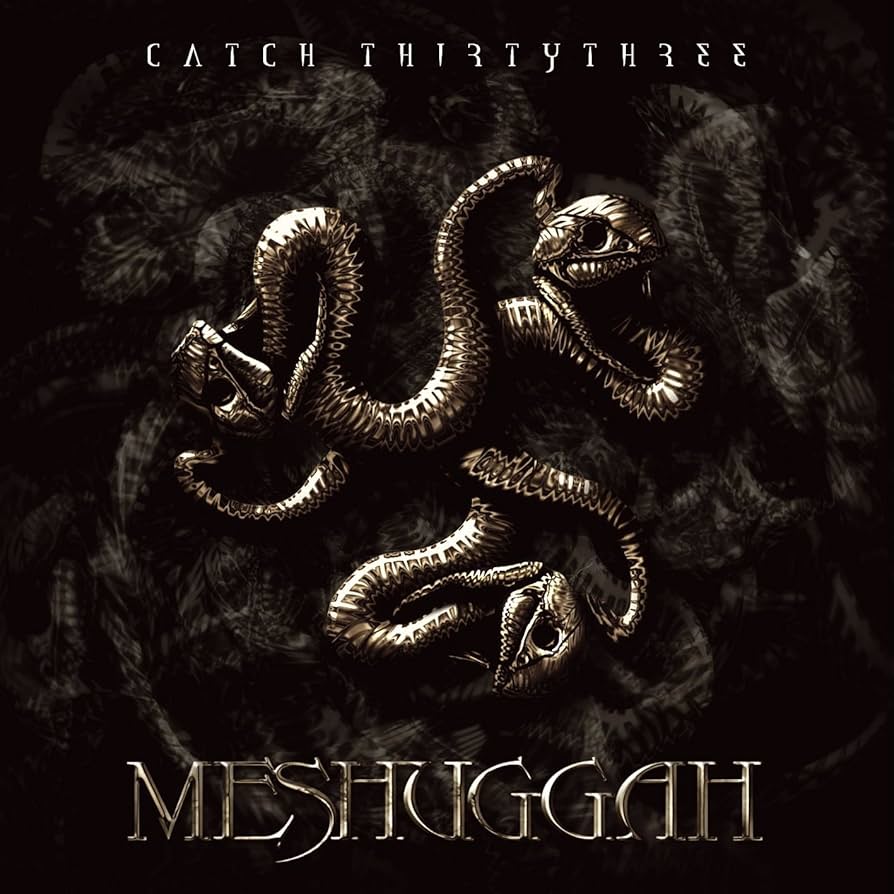
The album explores the paradoxes of existence, the ego, and the “Catch-22” of the human condition. The title is a play on Catch-22 (a situation where you can’t win because of contradictory rules). The album suggests that the “self” or the “ego” is a trap. The more you try to understand yourself, the more you realize “you” don’t really exist as a separate entity. The struggle to be free from your mental chains actually becomes the chain itself.
That’s how I felt about Death. My constant struggle to somehow escape it, had shackled me to it. I was forced to face it.
The track “In Death - Is Life” is followed by “In Death - Is Death.” It suggests that life and death are just two sides of the same coin, and the “Truth” is found in the middle of that conflict. A lot of the songs describe a “shattering” of the personality, where the individual “self” is destroyed and then integrated into a universal, chaotic whole.
When I first heard this album and read the lyrics, I almost started to believe there was something greater than myself to be experienced. Not a “God”, but a universal truth. That somehow we are “all one”. It didn’t stick for long (I’m a cynic at heart) and Meshuggah are much more nihilistic than spiritual:
💬 CITE
“My ignorance cast in the mold of all things absolute.
I sustain forever my gaze. A stare fixed on the distant oblivion.
Resting in the inverted state of being dead, non-sensory matter.”
– Re-Inanimate
I’ll be honest, I’m trying really hard not to quote this entire album right now. So many of the lyrics (along with the music itself, the sheer intensity of it) make me feel not just “alive” but genuinely seen and heard:
💬 CITE
“Treacherous this deceit to make no choice matter.
To have and yet lose yourself, until finally all reasons why are forgotten.
To live through ones own shadow. Mute and blinded, is to really see.
Eclipse the golden mirror and the reflection is set free.”
– Mind’s Mirrors
OK, last one, I promise:
💬 CITE
“I float through physical thoughts.
I stare down the abyss of organic dreams.
All bets off, I plunge - Only to find that self is shed.”
– Shed
Ironically, in most Eastern traditions you’re expected to accept death from a very young age because the sooner you start thinking about it, and worrying about it, the more prepared you’ll be on your deathbed. I’ve struggled to accept this. I flip-flop between thinking it’s the right way and disagreeing entirely. I couldn’t imagine being ignorant my entire life and then on my deathbed suddenly going “wait, oh no, shit, I’m going to die! What if there is no God?!”, having all those emotions and feelings I had at six years old suddenly appear in that final moment. Maybe it was better I’ve been tormented for all these years, because at least I’m more ready for that moment when it comes.
To be clear: I’m not ready. I will never truly be ready. But I stand a better chance of dealing with it this way than the other way around. It sucks either way, doesn’t it.
Louder than Death
Music has been my support structure for probably 90% of the time I’ve been alive. I listen every day, across a very eclectic range of genres. But I also listen to a lot of challenging stuff: improvisational, avant-garde, heavy, dark. My two favourite bands are Sunn O))) (see also my post on Drone) and SUMAC.
My friends and family never could quite understand why I had such an interest in dark music. Honestly, for years I didn’t either. It took me a long time to realise that the heavy, avant-garde, formless stuff I kept reaching for was the only art I’d found that looked directly at death without flinching, or dressing it up, or promising me it would be fine. It stares at oblivion and makes a sound out of it. That’s the thing I could never do on my own.
Take The Red Dragon, William Blake’s painting from the 1800s. It’s an apocalyptic vision, the end of everything, painted from the Book of Revelation. I came to know it through the 1981 novel “Red Dragon” by Thomas Harris, where the killer believes the painting is transforming him into something beyond human. He wants to destroy what he is. That’s not really a story about violence, it’s a story about someone so terrified of being a person that he’d rather be annihilated into something else. I recognised that feeling immediately.
The first time I heard “I Am Colossus” by Meshuggah, I could feel my body morphing into something else as the song played. Not in a horror-movie way. In the Jung way. The ego getting dissolved, briefly, on purpose, while I sat there safely on my sofa. That’s when I understood what music was actually doing for me. It was giving me a controlled taste of the thing I’d been terrified of my whole life. This is probably why a lot of metalheads turn out to be some of the kindest, most patient people on the planet. They’ve already been down there.
My family and friends just hear noise. When you play them something like Sunn O))), something devoid of melody or structure, they probably question whether I’m “right in the head”.
I’ve come to realise that I gravitate towards chaotic sounds because they drown out the chaos already going on inside me. My monkey mind is so chatty and paranoid and scared that I need something louder than it is. That’s why music helps me deal with my panic and fear. It’s a way for the ego, all that noise inside my head, to be swallowed up.
Still here, still scared
There is the saying “Pulvis et umbra sumus,” a Latin phrase that translates to:
💬 CITE
“We are dust and shadow.”
– Horace
It comes from the Roman poet Horace (Odes, Book 4, 7). The line reflects a classic theme in ancient philosophy and poetry: the fleeting, fragile nature of human life. Pulvis is dust, umbra is shadow, and sumus means we are. Together, it suggests that human existence is insubstantial and temporary, like dust scattered by wind or a shadow that quickly fades.
It’s a cheery thought for any time of day, but it’s a stark reminder of the very thing that’s been keeping me awake for decades, that constant, low-frequency hum of mortality that doesn’t ever really go away.
So where am I today? Basically the same place I was at six years old: scared, and constantly trying to find ways not to lose my mind to panic on a nightly basis. I have kids, so I try to put my focus into them and to appreciate every moment I’m conscious, whether that means walking along the seafront and feeling the sun on my face, or getting caught in the pouring rain and feeling the wind blowing through me and the water running over my skin. Either way, I’m alive, and I’m grateful I get another day. Because let’s face it, one day I might go to sleep and never wake up.
And in some way, that’s probably a blessing in disguise.